DJP

डॉल्फ़िन ज़िंदा पार्टी

Dolphin
Jinda Party

A coal plant sits on the left bank of the Chambal, two kilometres from Kota. It fails its own pollution limits, has outlived its own retirement plan, and was fined by the National Green Tribunal for polluting the river. Downstream live the Gangetic dolphin, the gharial, and more than a million people. We are the party for all of them.

चंबल बचाओ, कोटा बचाओ। डॉल्फ़िन बचेगी, तो हम बचेंगे।

The plant

Kota Super Thermal Power Station

State-owned, coal-fired, and drinking from the same river that carries Kota's dolphins and gharials downstream.

The plant is run by the Rajasthan state utility (RRUVNL). It stands in Sakatpura on the left bank of the Chambal, about 2 km from the city. It has seven units with a combined 1,240 MW[1].

The Centre for Science and Environment found that six of the seven units fail particulate matter norms, and every unit fails the sulphur dioxide and water norms set by the environment ministry. Units 1 to 4 were fitted with dust filters (ESPs) built for 150 mg/Nm³ of particulate output, while the legal limit is 100. Those units have no plan for flue gas desulphurisation[1].

Cooling Units 1 to 5 takes an open-cycle flow of 1,180 cusecs from the Kota Barrage, and the warmed water goes back to the river. In 2021 the effluent and sewage treatment plants existed only as submitted plans[1].

The city breathes it too. Kota is a non-attainment city under the National Clean Air Programme, which means its air fails national standards[2]. A 2024 study of 47 indoor dust samples from Kota homes concluded that coal burning at the plant is the major source of the heavy metal burden in the study area[5].

Seven units, one report card

CSE assessment, reported June 2021

PMSO₂Water

Red means the unit fails the norm. CSE did not say which unit meets the PM limit, so it is shown here as Unit 7, the newest. All seven fail SO₂ and water.
1,20,000 m³/hrCooling water the plant draws from the Chambal at the Kota Barrage.Down To Earth, 2021
20 paise/unitThe penalty under the 2021 rules, which lets a plant that misses the norms keep running.MoEF&CC amendment, 1 Apr 2021
₹3.6 croreNGT fine on the power station for polluting the Chambal. The same fine was imposed on Kota's municipal corporation.NGT Bhopal, 10 Oct 2025
35%Share of Kota's houses connected to the sewer: 49,890 of 1,41,568. The rest drains toward the river.NGT order, 2025
From above · हवा, पानी, मिट्टी

The air, water and soil we live in

Satellite views of the plant and the land around it. Anyone can open these maps and check the same places for themselves. Tap a photo to see it full size.

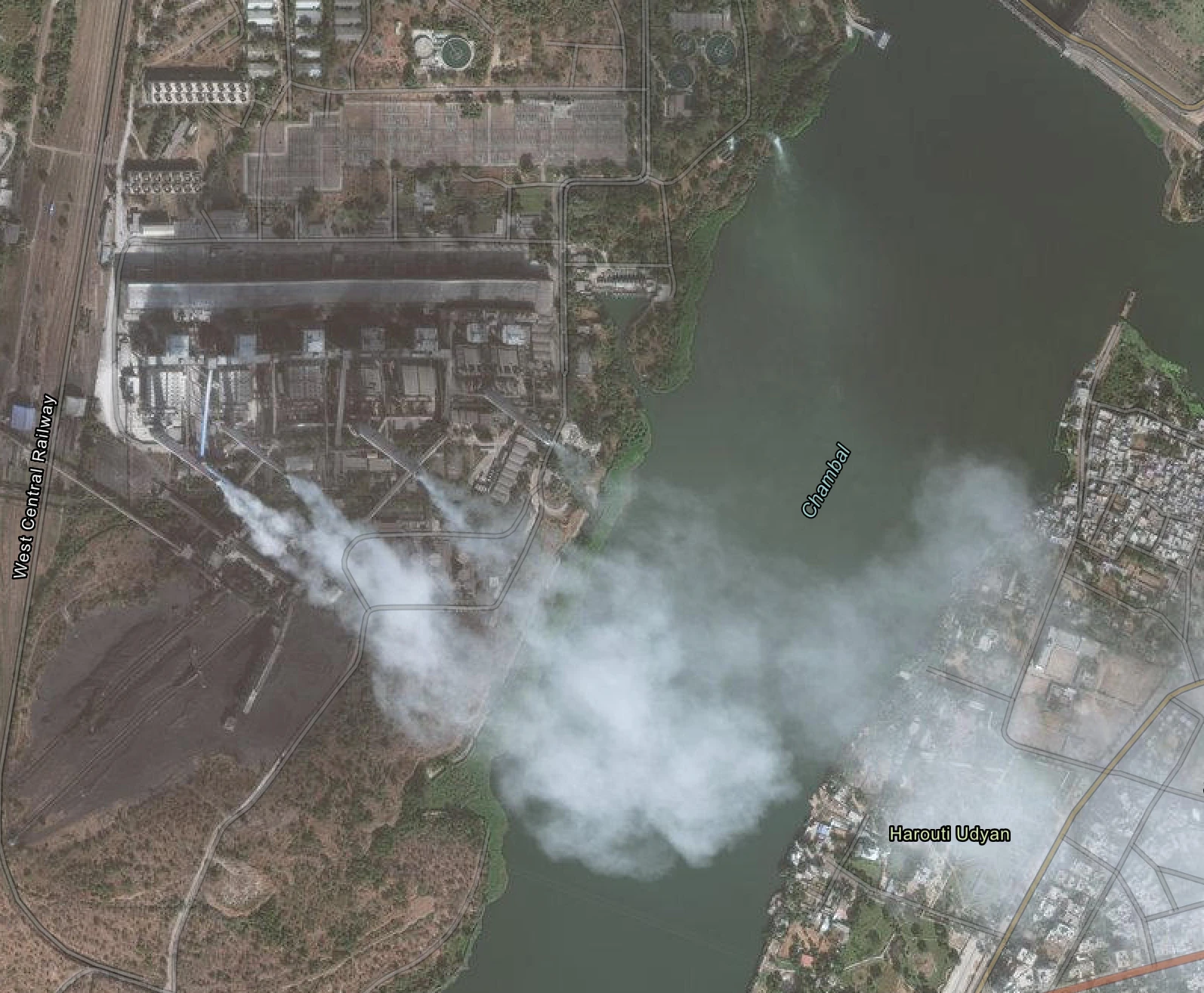
Satellite view of the Kota thermal plant on the Chambal, with white smoke plumes drifting across the river over Harouti Udyan and nearby homes
Air · हवाSmoke over the river and the cityPlumes from the chimneys drift across the Chambal toward Harouti Udyan and the homes on the far bank. This is the air Kota breathes.
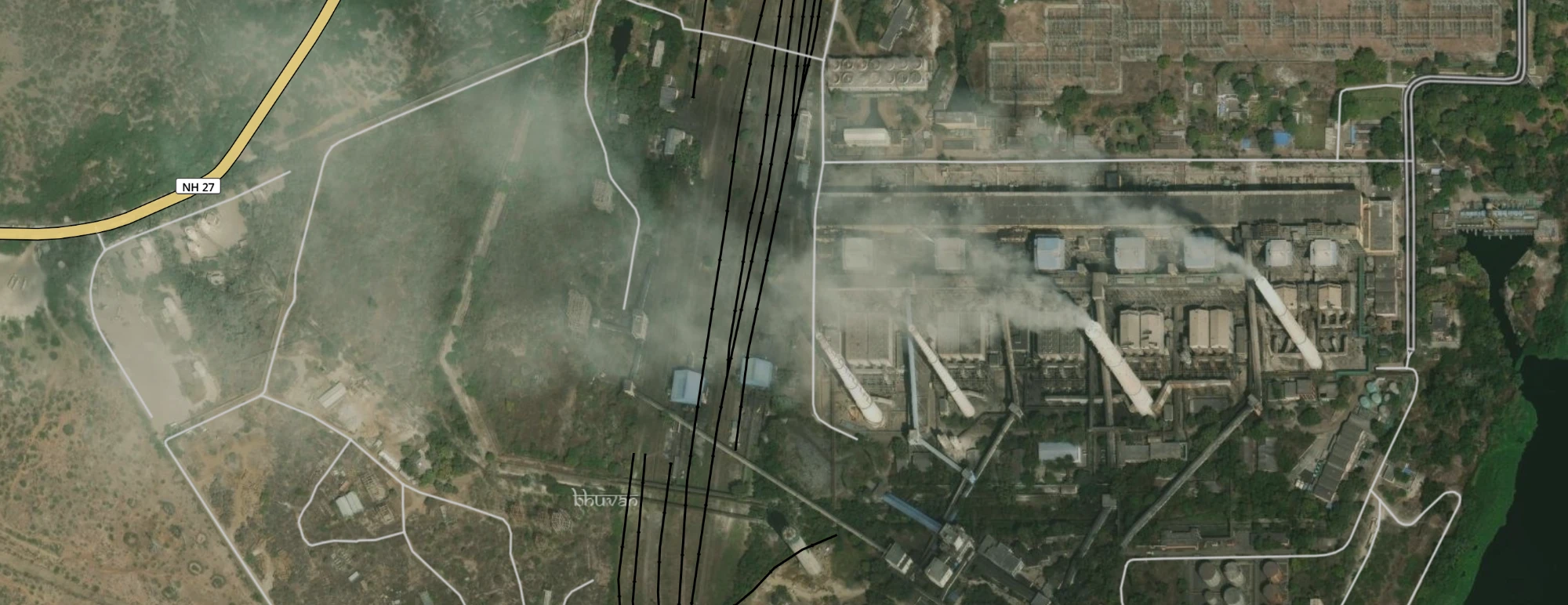
Overhead view of the plant's tall stacks, several emitting smoke that spreads west over the site
Air · हवाSeveral stacks at onceSmoke from several stacks spreads low over the plant and the land beside NH 27.
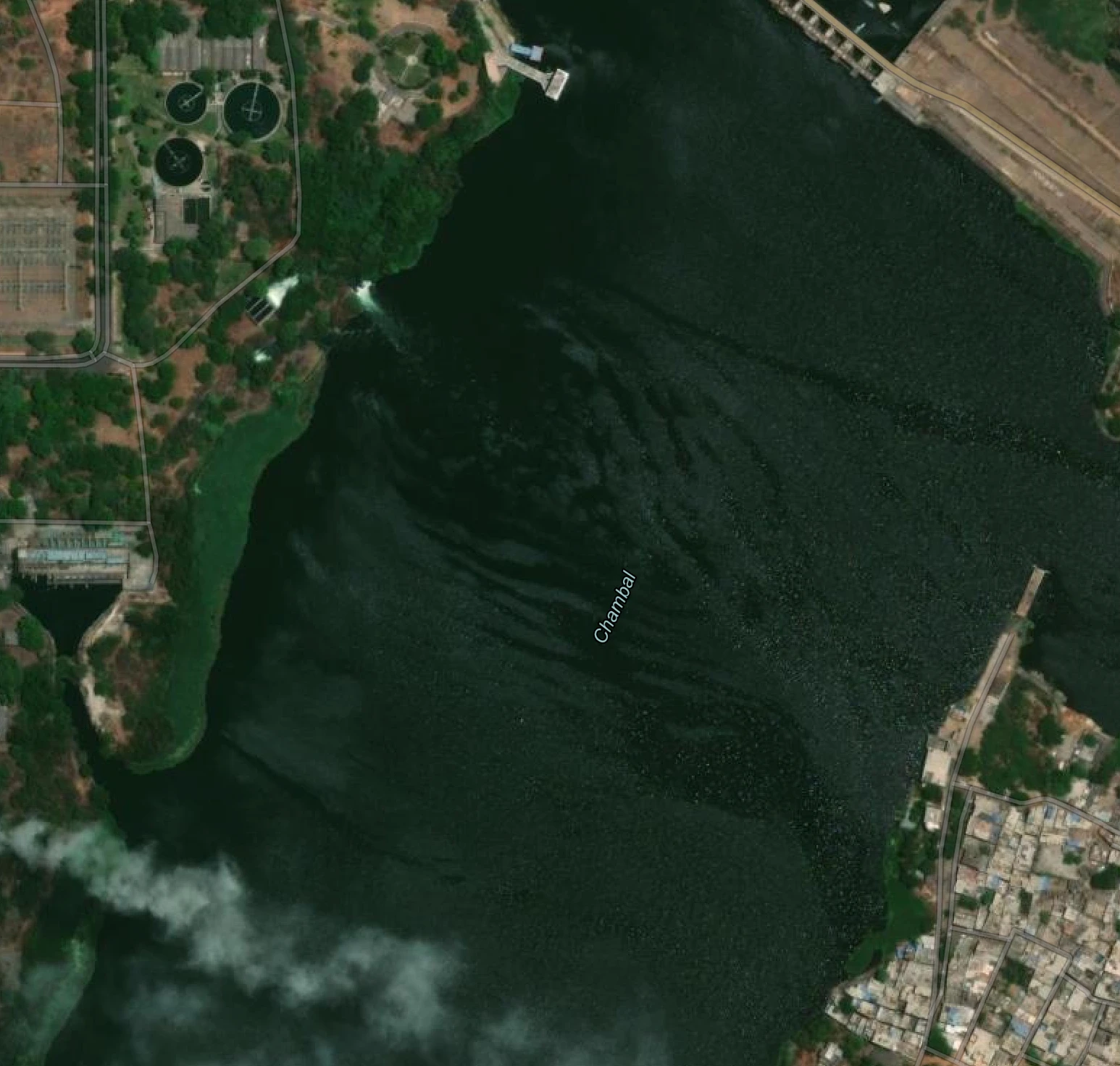
The Chambal beside the plant, with white jets of water entering from the bank and dark streaks spreading across the river
Water · पानीPouring into the ChambalWhite jets where water pours into the river from the plant's bank, with streaks spreading downstream. In October 2025 the NGT ordered the plant to stop polluted water flowing into the Chambal.
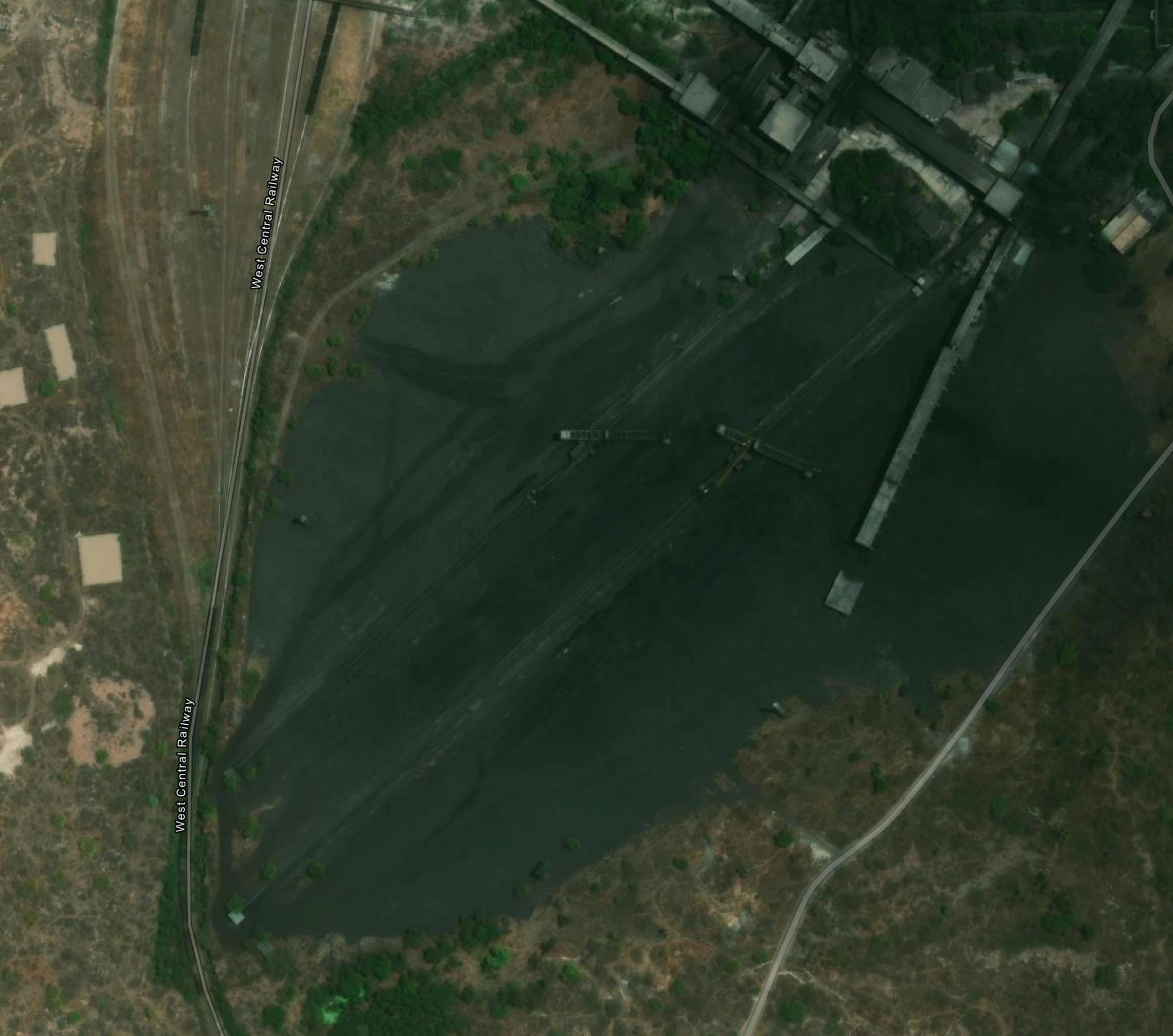
Large black coal stockyard with stacker-reclaimer machines next to the railway line
Land · ज़मीनThe coal yardA black field of open coal piles beside the West Central Railway line, exposed to wind and rain.
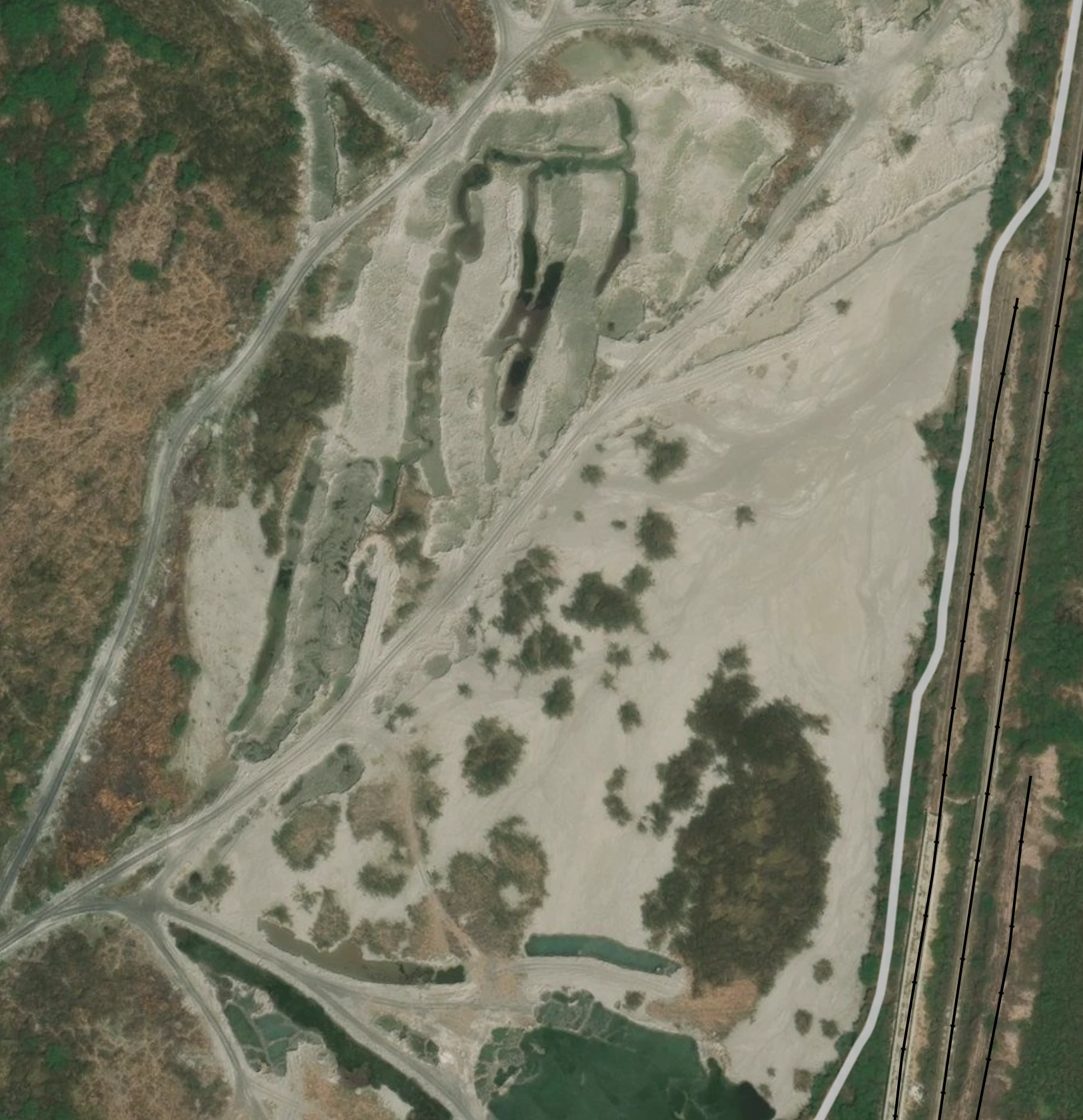
Grey fly ash pond with slurry channels and patches of trees surrounded by ash
Soil · मिट्टीAn ash pondGrey fly ash slurry settles in channels and spreads around the trees standing in it.
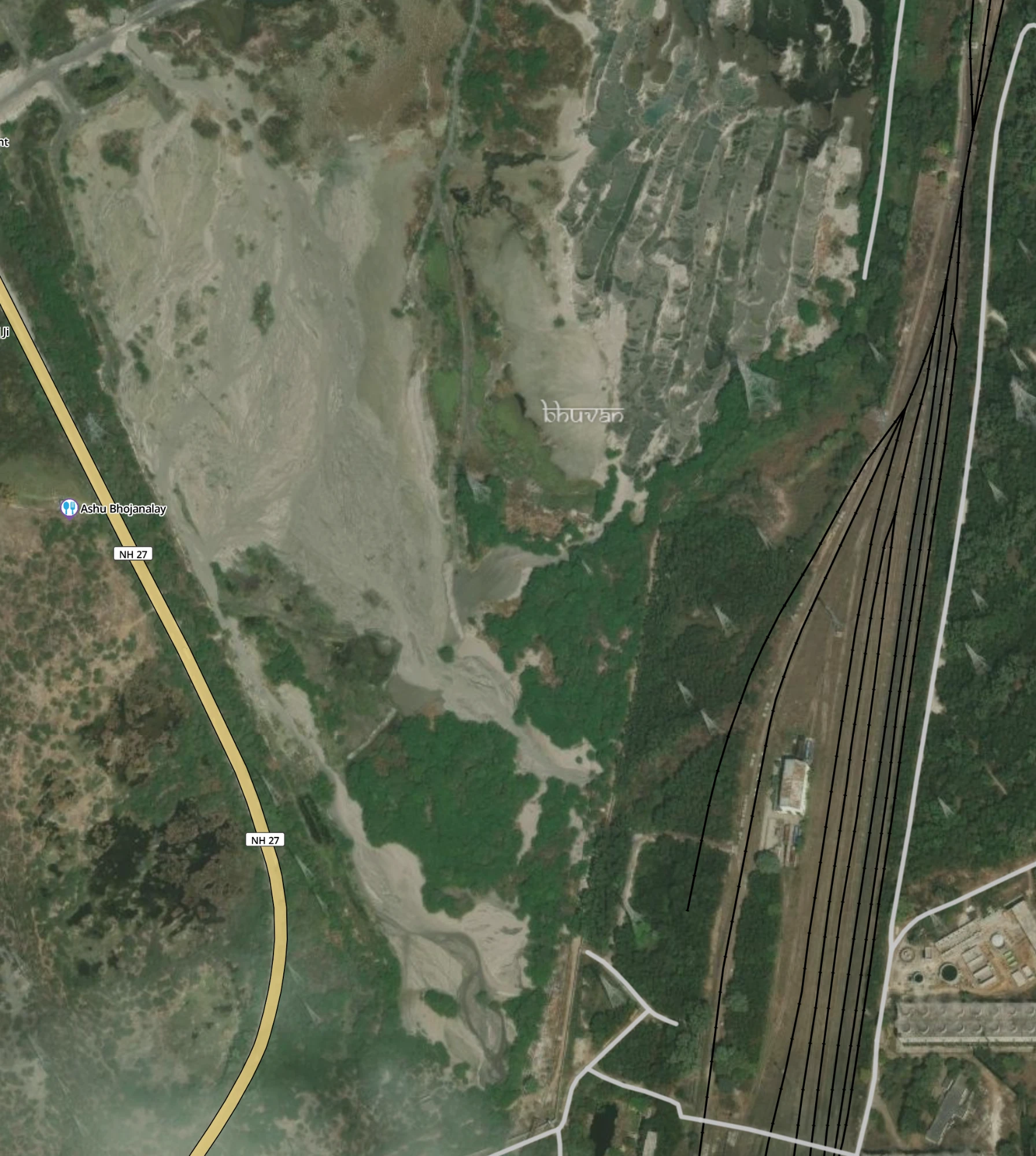
Grey ash deposits spreading in fan shapes into green vegetation next to the NH 27 highway
Soil · मिट्टीAsh beside the highwayGrey ash deposits beside NH 27 spread in fans into the green land around them.

Imagery: ISRO Bhuvan and public satellite maps.

The record

A plant that keeps missing its own deadlines

The oldest units were scheduled to retire years ago. Each deadline slipped, and the river paid for it.

  1. National emission norms notified

    The environment ministry sets new limits on PM, SO₂, NOx, mercury and water use for coal plants.

  2. Retirement agreed Not done

    After talks with the CEA and CPCB, the plant is slated for retirement. The CEA's National Electricity Plan lists Units 1 to 5 for closure[1].

  3. Deadline for Units 1–4 Missed

    This was the date to phase out Units 1 to 4, and the CPCB's deadline for their ESP upgrades.

  4. The rules are loosened

    The ministry extends compliance deadlines by three to four years. Old plants can run to 2025 on a retirement plan, and defaulters can keep running by paying 20 paise a unit. CSE calls it a license to pollute[1].

  5. Retirement of Units 1–2 reversed Reversed

    Units 1 and 2 (110 MW each) were due to shut on 30 June. Two days before, the state government said the plant would keep running to protect jobs[1].

  6. Water-use standard deadline for Units 1–5

    The cooling system was to meet specific water consumption limits by this date.

  7. NGT fines the plant ₹3.6 crore

    Acting on a PIL by environmentalist Babulal Jaju, the NGT's Bhopal bench orders the plant to stop polluted water entering the Chambal immediately, and to build cooling towers and treatment facilities[3].

  8. NGT deadline Has it been met?

    This was the deadline for the cooling towers, the treatment works, and sewer connections for every house in Kota. The deadline has passed. No compliance status has been published, and we are demanding one.

Downstream

Who lives below the outfall

Below Kota, the Chambal flows through the National Chambal Sanctuary, about 425 km of protected river[3]. The NGT itself noted that pollution, illegal mining and encroachment threaten human life, the gharial and the Gangetic dolphin.

Endangered

Gangetic river dolphin

Platanista gangetica · सोंस

India's national aquatic animal. It is nearly blind and finds food and mates by echolocation, so it depends on clean, flowing, quiet water. Heavy metals build up in the fish it eats. A river with healthy dolphins is a river that is safe for people.

Critically endangered

Gharial

Gavialis gangeticus · घड़ियाल

The Chambal is one of the gharial's last strongholds, and the sanctuary was created to protect it[3]. It nests on sandbanks, the same sandbanks threatened by illegal mining and polluted flows.

Breathing it daily

The people of Kota

Sakatpura and every ward downwind

We are students, families and plant workers. We breathe air that fails national standards and live in homes where the dust carries metals traced to coal burning[5]. Researchers have studied heavy metal pollution around the plant since at least 2018[4].

Manifesto · घोषणापत्र

Seven demands

Each demand rests on a rule, plan or court order that already exists. We are asking for those commitments to be enforced.

  1. Publish the March 2026 status

    RRUVNL and the Rajasthan pollution board must publish whether the plant has met the NGT's orders on cooling towers, treatment and discharge, with dates and evidence.

  2. Retire Units 1–5 as planned

    The CEA's own National Electricity Plan scheduled these units for retirement. The oldest units fail the norms and have no plan to meet them.

  3. End pay-to-pollute

    A 20-paise penalty is not compliance. Every unit that runs must meet the 2015 norms, or it must stop.

  4. Zero discharge into the Chambal

    Stop every polluted flow, as the NGT ordered. Switch to closed-cycle cooling towers, and commission the effluent and sewage plants that have existed only on paper.

  5. Monitor health and heavy metals

    Run independent, public testing of air, soil, river water, fish and indoor dust in Sakatpura and the downwind wards, then fund health screening based on the results.

  6. Protect the sanctuary

    Count dolphins and gharials every year and publish the results. Enforce the 2016 and 2020 sand mining guidelines on the Chambal, as the NGT directed.

  7. A just transition for workers

    Every worker at a retiring unit gets redeployment, retraining for clean energy and ash-remediation jobs, or full protection of their pay. Jobs must never again be the reason a dirty unit keeps running.

✊

The plant's workers are not our opponents. In 2021 the retirement was cancelled to save their jobs. Our answer is a plan that protects their jobs and the river at the same time.

Plant workers and union members are welcome in the DJP, and their voices shape demand seven.

Join · जुड़िए

Become a member

A movement grows one person at a time. Take the pledge, share your card, and bring one more person with you.

  • →

    Take the pledge

    Fill in the form to make your DJP card, then share it on WhatsApp or anywhere else.

  • →

    Ask in writing

    Send an RTI application to RRUVNL and the Rajasthan State Pollution Control Board asking for the plant's compliance with the NGT order of 10 October 2025. Use the RTI text below.

  • →

    Bring it to your ward

    Raise the seven demands at your ward meeting, your RWA, your coaching centre, your college.

  • →

    Go to the river

    Join a Sunday walk along the Chambal ghats. Photograph outfalls, foam, ash and dead fish, and note the date and place.

The DJP pledge · संकल्प

I pledge to

DJP organisers store your name, area and number so they can contact you about meetings and river walks. They are never shown on this site or shared. Only the total number of members is public.

Sources

Every claim, cited

This movement runs on public records. Check every source yourself.

  1. [1]License to pollute: Inefficient Kota thermal power station allowed to function by RajasthanDown To Earth · Soundaram Ramanathan · 30 June 2021
  2. [2]Factsheet of industrial emissions in KotaCentre for Science and Environment · 22 July 2024
  3. [3]NGT imposes Rs 3.6 cr fine each on Kota's municipal corporation, power plant for polluting ChambalThePrint / PTI · 17 October 2025 · order dated 10 October 2025
  4. [4]Heavy metal pollution assessment around Kota Super Thermal Power PlantResearchGate · 2018
  5. [5]Determination of heavy metals in indoor dust in the vicinity of Kota Thermal Power Plant under meteorological influenceCurrent World Environment · 2024